| The U.S. Has No Specific Diagnosis Code for COVID-19 Vaccine Adverse Effects — A Proposed Fix Is Now Before the CDC
For the first time, the federal agency that maintains the nation’s medical coding system has proposed a dedicated code for adverse effects of COVID-19 vaccines. Here’s what it means, why it matters, and what happens next. |
| More than four years into the rollout of COVID-19 vaccines, the United States still has no specific diagnosis code to document adverse health conditions that arise from them. That may be about to change. At the March 17–18, 2026 ICD-10 Coordination and Maintenance Committee Meeting, the National Center for Health Statistics (NCHS) presented a formal proposal to add T50.B25x Adverse Effect of COVID-19 Vaccines, to the ICD-10-CM code set used by every U.S. healthcare provider, hospital, insurer, and public health agency.
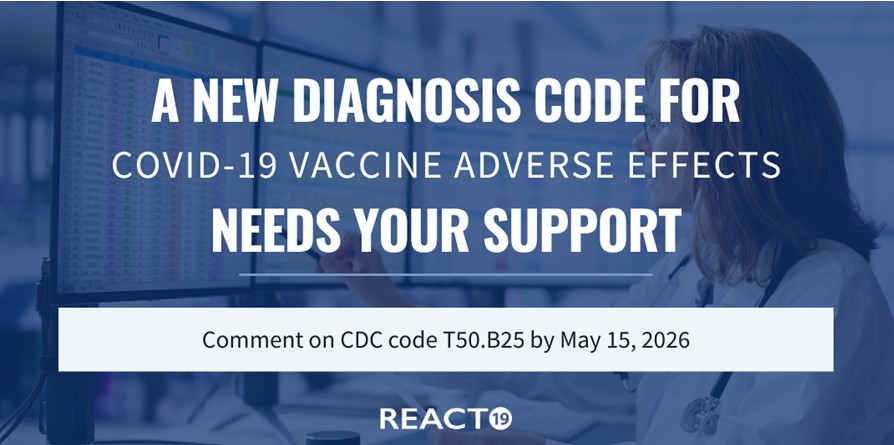
The proposal was brought forward in response to a request from React19, a nonprofit organization representing individuals experiencing persistent health conditions following COVID-19 vaccination. The public comment period is now open, and comments must be submitted to NCHS by Friday, May 15, 2026.
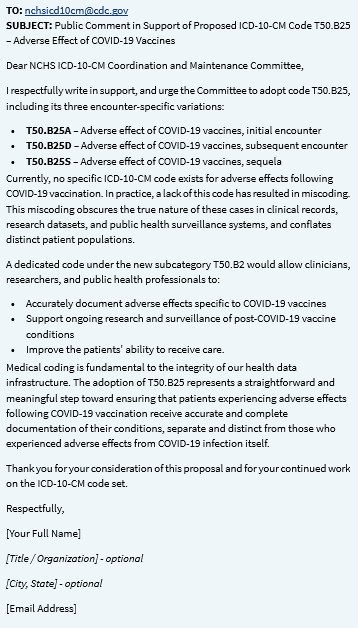
What did REACT19 present to the CDC? We are sharing this with you first: |
| What Is ICD-10-CM and Why Does It Matter?
The International Classification of Diseases, 10th Revision, Clinical Modification (ICD-10-CM) is the standardized system U.S. providers use to classify and document diagnoses. These codes drive everything from insurance reimbursement and hospital resource allocation to public health surveillance and clinical research. When a condition lacks its own code, it becomes invisible, providers have no reliable way to document it, researchers have no way to count it, and policymakers have no data to act on.
The importance of dedicated codes was demonstrated clearly with the October 2021 introduction of U09.9 (Post-COVID-19 condition, unspecified) for Long COVID. That single code enabled systematic documentation of Long COVID cases across the country, supported surveillance, and helped launch a wave of clinical and epidemiological research, even before the full biology of the condition was understood. |
| “In practice, the absence of a specific code has led to widespread miscoding of COVID-19 vaccine adverse effects under U09.9 Long COVID, conflating two distinct patient populations and corrupting the data for both.” – Dr Joel Wallskog |
|
|
|
| This is not a minor administrative inconvenience. The downstream consequences are significant: patients are misdocumented in their medical records, the true incidence of post-COVID vaccination adverse conditions is unknown, research cohorts are contaminated with misclassified patients, and individuals seeking disability benefits or continuity of care face documentation gaps that undermine their cases. |
|
| What the Proposal Creates
REACT19 proposed a new sub-subcategory, T50.B and 3 new codes: |
| T50.B25A / T50.B25D / T50.B25S |
These three variations are critical. The inclusion of a sequela designation (T50.B25S) is particularly significant for patients experiencing prolonged or chronic post-vaccination conditions, as it provides a mechanism to document the ongoing relationship between a patient’s current symptoms and their prior vaccination — something the current nonspecific codes cannot accomplish.
When used correctly, T50.B25 would be assigned as a secondary code alongside specific manifestation codes describing the patient’s actual symptoms or conditions. |
|
|
|